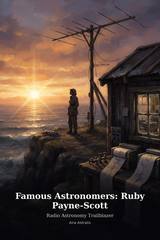
Famous Astronomers: Ruby Payne-Scott: In 1945, at a borrowed radar station above the Pacific, Ruby Payne-Scott heard the Sun's radio storms and helped found a science that did not yet have a name. This is her story: the physicist who classified the solar bursts still used to forecast space weather, who helped confirm the million-degree corona by radio, and whose cliff-top interferometer, using the ocean as a mirror, introduced the Fourier reasoning behind every modern radio telescope. It is also the story of the rule that ended her: the marriage bar that forced her resignation in 1951, the six-year secret that tried to outwit it,
DRM-free EPUB + PDF
In 1945, at a borrowed radar station above the Pacific, Ruby Payne-Scott heard the Sun's radio storms and helped found a science that did not yet have a name. This is her story: the physicist who classified the solar bursts still used to forecast space weather, who helped confirm the million-degree corona by radio, and whose cliff-top interferometer, using the ocean as a mirror, introduced the Fourier reasoning behind every modern radio telescope. It is also the story of the rule that ended her: the marriage bar that forced her resignation in 1951, the six-year secret that tried to outwit it,.
Space & Astronomy Starter Set: 5 books for S$6.90 →
Also on Payhip Ko-fi itch.io Fourthwall
Table of contents
- Introduction
- Chapter 1: The Discovery of Ruby Payne-Scott
- Chapter 2: Understanding Ruby Payne-Scott
- Chapter 3: Key Characteristics of Ruby Payne-Scott
- Chapter 4: The Science Behind Ruby Payne-Scott
- Chapter 5: Ruby Payne-Scott in Context
- Chapter 6: Important Features of the Payne-Scott Story
- Chapter 7: Observation and Measurement in Her Era
- Chapter 8: Modern Understanding of Her Work
- Chapter 9: Research and Exploration of Her Career's Program
- Chapter 10: Significant Discoveries About Ruby Payne-Scott
- Chapter 11: Challenges and Mysteries of Ruby Payne-Scott
- Chapter 12: Future Directions in Her Legacy
- Chapter 13: Fun Facts and Trivia About Ruby Payne-Scott
- Chapter 14: Conclusion: The Significance of Ruby Payne-Scott
- Conclusion