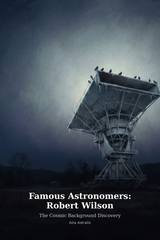
Famous Astronomers: Robert Wilson: The man who heard the universe begin. This is the story of Robert Woodrow Wilson, the Texas-born radio astronomer whose stubborn checking of a noisy antenna at Bell Labs in 1964 and 1965 led to the discovery of the cosmic microwave background, the cooled afterglow of the Big Bang. From his Houston boyhood and radio apprenticeship in the California desert, through the ten months of excluding every mundane explanation, the evicted pigeons and their white dielectric material, the telephone call to Princeton that supplied the missing theory, and the Nobel Prize of 1978, to his second great discove
DRM-free EPUB + PDF
The man who heard the universe begin. This is the story of Robert Woodrow Wilson, the Texas-born radio astronomer whose stubborn checking of a noisy antenna at Bell Labs in 1964 and 1965 led to the discovery of the cosmic microwave background, the cooled afterglow of the Big Bang. From his Houston boyhood and radio apprenticeship in the California desert, through the ten months of excluding every mundane explanation, the evicted pigeons and their white dielectric material, the telephone call to Princeton that supplied the missing theory, and the Nobel Prize of 1978, to his second great discove.
Space & Astronomy Starter Set: 5 books for S$6.90 →
Also on Payhip Ko-fi itch.io Fourthwall
Table of contents
- Introduction
- Chapter 1: The Discovery of Robert Wilson
- Chapter 2: Understanding Robert Wilson
- Chapter 3: Key Characteristics of Robert Wilson
- Chapter 4: The Science Behind Robert Wilson
- Chapter 5: Observation and Measurement of Robert Wilson
- Chapter 6: Important Features of Robert Wilson
- Chapter 7: Robert Wilson in Context
- Chapter 8: Modern Understanding of Robert Wilson
- Chapter 9: Research and Exploration of Robert Wilson
- Chapter 10: Significant Discoveries About Robert Wilson
- Chapter 11: Challenges and Mysteries of Robert Wilson
- Chapter 12: Future Directions in Robert Wilson Research
- Chapter 13: Fun Facts and Trivia About Robert Wilson
- Chapter 14: Conclusion: The Significance of Robert Wilson
- Conclusion