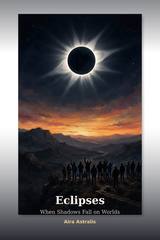
Earth's Sky: Eclipses: Twice a year, on average, the Sun goes out in the middle of the day. This is the story of eclipses: the Babylonian scribes who found the rhythm and tamed the omen, the Greek geometry that turned fear into a clock, the war that legend says a shadow stopped, the 1868 expedition that found helium in the Sun's edge, the 1919 photographs that bent light around Einstein's universe, and the million-degree corona that still gathers aircraft, spectrographs, and millions of onlookers under the Moon's shadow. Written for the general reader, it explains the geometry of nodes and shadow cones, the saros ar
DRM-free EPUB + PDF
Twice a year, on average, the Sun goes out in the middle of the day. This is the story of eclipses: the Babylonian scribes who found the rhythm and tamed the omen, the Greek geometry that turned fear into a clock, the war that legend says a shadow stopped, the 1868 expedition that found helium in the Sun's edge, the 1919 photographs that bent light around Einstein's universe, and the million-degree corona that still gathers aircraft, spectrographs, and millions of onlookers under the Moon's shadow. Written for the general reader, it explains the geometry of nodes and shadow cones, the saros ar.
Space & Astronomy Starter Set: 5 books for S$6.90 →
Also on Payhip Ko-fi itch.io Fourthwall
Table of contents
- Introduction
- Chapter 1: The Discovery of Eclipses
- Chapter 2: Understanding Eclipses
- Chapter 3: Key Characteristics of Eclipses
- Chapter 4: The Science Behind Eclipses
- Chapter 5: Observation and Measurement of Eclipses
- Chapter 6: Important Features of Eclipses
- Chapter 7: Eclipses in Context
- Chapter 8: Modern Understanding of Eclipses
- Chapter 9: Research and Exploration of Eclipses
- Chapter 10: Significant Discoveries About Eclipses
- Chapter 11: Challenges and Mysteries of Eclipses
- Chapter 12: Future Directions in Eclipses Research
- Chapter 13: Fun Facts and Trivia About Eclipses
- Chapter 14: Conclusion: The Significance of Eclipses
- Conclusion